
Most mornings in Bradford I chant and I meditate. When someone asks what I am doing, I answer. When they don’t, I leave them alone. I choose not to promote any religion, even Buddhism — everyone’s path is their own.
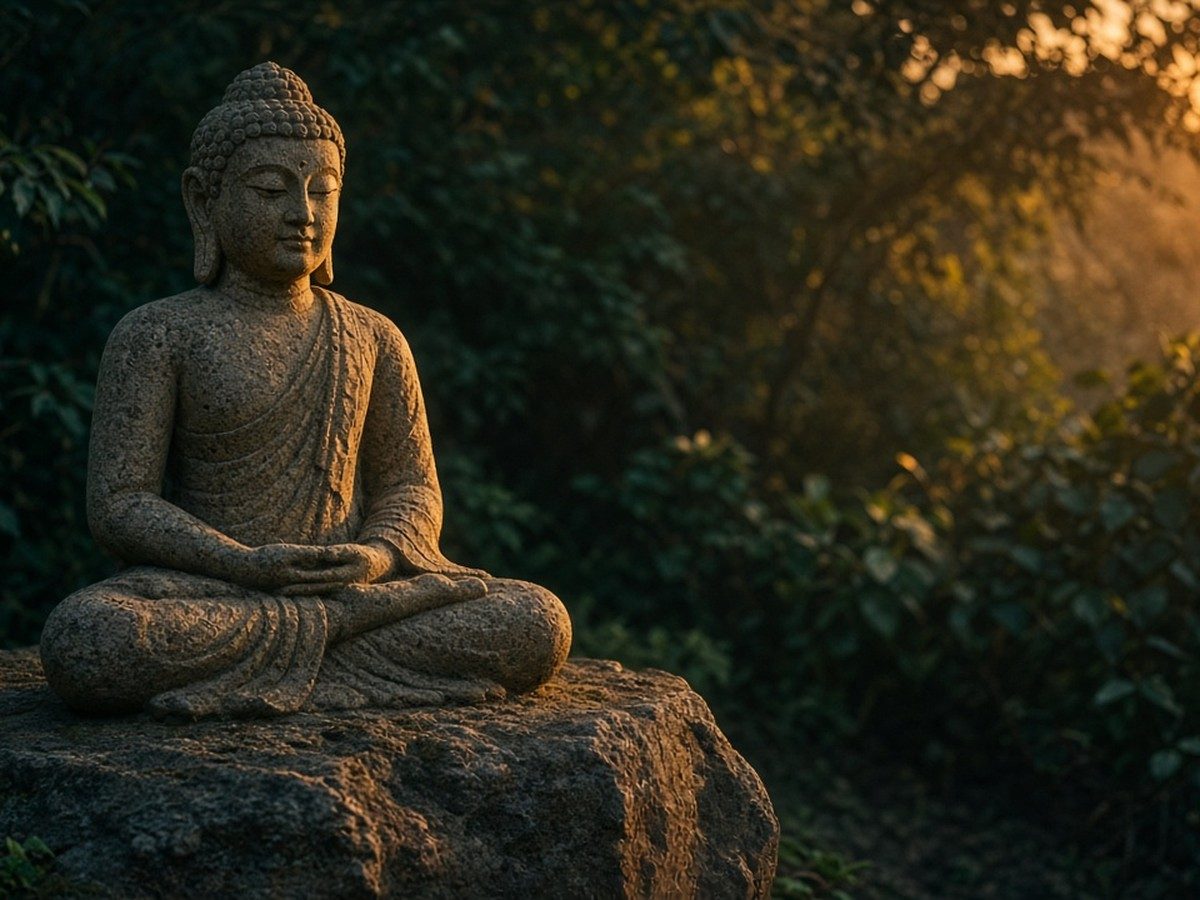
The Chinese Buddha illustration in this post has a small 卍 on his chest. In Chinese temples it has stood for good fortune and a happy heart for centuries, long before Europe learned to fear a twisted copy of it.
Three voices on not harming
I have sat with Franciscan brothers at St Pio Friary in Bradford, and later volunteered at the Immanuel Project and the Jubilee Centre. The brothers never once minded talking about Buddhism with me. Some of our best conversations happened over a stack of plates. That kind of talk between traditions isn’t new — Father Francis Tiso, a Catholic priest, has spent years encouraging Christians and Buddhists to sit down together. I wrote about that slower mind at the sink in A Slower Mind at the Sink.
What I keep noticing is how often the teachings themselves point the same way on violence — and how rarely the killers listen to them.

In Buddhism, the first precept is plain: I undertake to refrain from killing living beings. The Dhammapada puts the same heart into verse. “Hatred is never appeased by hatred in this world. By non-hatred alone is hatred appeased. This is a law eternal” (Dhammapada 5, tr. Buddharakkhita). And: “All tremble at violence; all fear death. All tremble at violence; life is dear to all. Putting oneself in the place of another, one should not kill nor cause another to kill” (Dhammapada 129–130, tr. Buddharakkhita).
Jesus, in the Sermon on the Mount, blesses peacemakers (Matthew 5:9). He tells his hearers not to answer violence with violence, to turn the other cheek, and to love their enemies and pray for those who persecute them (Matthew 5:38–44). At his arrest he stops the sword: “Put your sword back into its place; for all who take the sword will perish by the sword” (Matthew 26:52).
The Qur’an speaks with the same gravity about life. “Whoever kills a soul… it is as if he had slain mankind entirely. And whoever saves one — it is as if he had saved mankind entirely” (Qur’an 5:32) — a verse often taught as a moral principle, and one that comes with named exceptions (for murder or corruption) in its own wording; I will not pretend those limits aren’t there. Fight those who fight you, but do not transgress (Qur’an 2:190) — permission with a brake, not a blank cheque. “There is no compulsion in religion” (Qur’an 2:256). And: God does not forbid you from being kind and just toward those who do not fight you because of religion or drive you from your homes (Qur’an 60:8).
Three different homes. One clear refusal to treat another person’s life as cheap.
When fear wears religious clothes
So why do people still kill while shouting sacred names?
Because fear, power, nationalism and tribal identity hijack the language of faith. The teaching gets pasted onto an “us” that must win. The killer feels like a saviour. That pattern is not owned by one tradition. Christians have done it. Muslims have done it. And Buddhists are not immune either — when Dharma talk is fused with fear of the neighbour and love of the flag, the first precept is already abandoned.
A short history lesson that still lands for me: Emperor Ashoka, after the slaughter at Kalinga, left rock edicts of remorse and turned toward care instead of conquest. That turn is what the teaching asks for — not the legend about how many brothers he killed before it. Remorse after violence is closer to the point than any heroic origin story.
Means and ends are not separate. If the end is peace, the means have to look like peace too. Taking the sword “for God” or “for Dharma” is still taking the sword.
Everyone’s path is their own
If someone asks why I practise, or what kept me after the years of reaching for anything that would stop the feeling — I wrote some of that in What I reached for, and what finally held — I’m happy to talk. The bees taught me the same thing in another key: every bee has its job, and every path is its own (I Didn’t Jump Out of a Plane. I Kept Bees.).

A calm table is enough. Sit, breathe, leave if you want. Bring your own tradition or none. If you ask, I will answer — then go back to the plates, or the hive, or the cushion, and leave the rest of the path to you.
What happens in you when someone else’s faith is treated as a threat instead of a neighbour?
Read next: Love Fully, Hold Loosely · This Post Won’t Save You